Hamster Care Book Reviews - 1990s
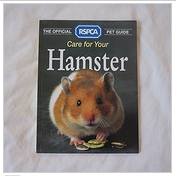
Hearne & Crush, 1990 (written by Hearne in 1983, updated by Crush in 1990) "The RSPCA Guide to Hamsters"
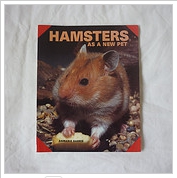
Otto Von Frisch 1990, Hamsters , How to Take Care of Them and Understand Them (A complete pet owners manual) which may or may not be Hamsters (Barron's Complete Pet Owner's Manuals Series)
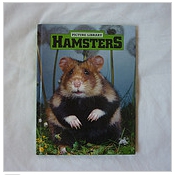
Vrbova, Zuza 1990 Hamsters (Junior Pet Care)
This may have been reissued in 1998 with input from Robert McAulay 1998
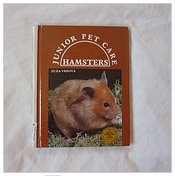
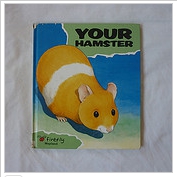
McKay, Jimmy, 1991, "The New Hamster Handbook"
5 stars - a truly comprehensive guidebook to hamster care with a level of information about areas such as hamster history that are rarely seen in other books.
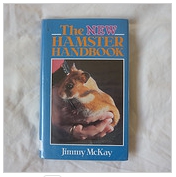
This book is called "The New Hamster Handbook" because it attempts to pick up where the original Pond and Deaton "Hamster Handbook" of 1956 left off, and become the single definitive collection of hamster-keepers knowledge in 1991. The result is a book that is still extremely worth reading twenty years later.
Piers, Helen, 1992, Taking Care of Your Hamster (Young Pet Owner's Guide)
This book with an updated cover, or a very similar version, is republished in 2002.
Mays, Marianne, 1993, The Proper Care of Hamsters, TFH

This author used to breed, show and judge hamsters in the UK under the prefix Lucinda
Barrie, Anmarie, 1994, "Hamsters for Those Who Care"
1 star - This is a very disappointing book riddled with factual errors! Less time should have been spent preparing the layout and more on writing the text...
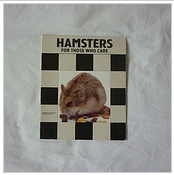
At first glance this book is fairly attractive and seems to contain a decent amount of hamster care information as well as many glossy photographs of various types of hamster in appealing poses. Unfortunately, once you start to read it is immediately obvious that the author was pretty much 'phoning it in' on the rest of the content - as well as 'errors' in topics where there is legitimately some difference of opinion through the years (such as stating that hamsters are herbivores but then suggesting that they also be supplied with animal protein sources), there are glaring factual mistakes all the way through the text. For example, on the first page alone there are multiple inaccuracies about the early dates in which hamsters were introduced to different countries. The colours section is also especially dubious, saying that the cinnamon gene is b (usually p) and labelling several pictures quite bizarrely. The whole book also appears to have been sponsored by Hagen (makers of Habitrail and assorted hamster supplies) or possibly cribbed heavily from Hagen promotional material, as many Hagen products are name-checked and illustrated throughout to an unusually great extent.
I would be interested to know if this was one of the "one week" books mentioned in this rather gossipy 'expose' of Herbert Axelrod of TFH publishing, as this title appears to have been much more hastily written than other hamster books also by Anmarie Barrie at TFH.
Hawkins, Colin and Hawkins, Jacqui, 1995, How to Look After Your Hamster, Walker Books
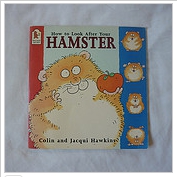
This book was first published in 1995 but the pictured edition is from 1996.
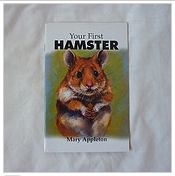
Anmarie Barrie 1996 Guide to Owning a Hamster (Accommodations, Feeding, Breeding, Exhibition, Health Care)
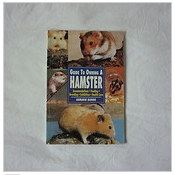
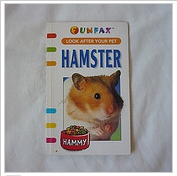
Engfer, LeeAnne, 1997, "My Pet Hamster and Gerbils"
A preview of this book can be read online for free here
Siino, Betsy Sikora 1997, Hamster: an Owners Guide To a Happy Healthy Pet
This book was reprinted in 2007, this is a picture of the 2nd edition
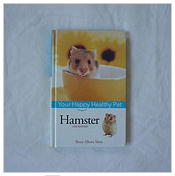
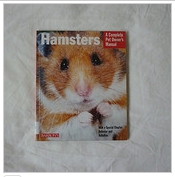
von Frisch, Otto, 1997, "Hamster" (in German) translated by Crawford, Elizabeth D., 1998, as "Hamsters: a complete pet owners manual", Barrons Educational Series, New York
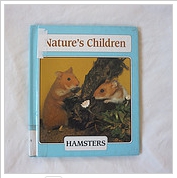
Elaine Landau, 1998, Your Pet Hamster (True Books: Animals) Children's Press (CT)
This book was reprinted in 2006 and 2007.
Hill, Lorraine, 1999, "The Really Useful Hamster Guide"
4 stars - nothing especially new or amazing but a good amount of detail and an overall sense that it is full of thorough practical advice from someone who has kept pet hamsters. A very good first book.
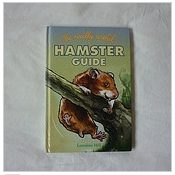
This book fits a lot of information into its 48 pages, as a result it is pretty comprehensive on the main things which a pet owner will need to know (for example there is a section on travelling with a pet hamster which is not usually covered to this extent, and good looks at topics such as body language/vocalisations, taming and illness). The book does not cover breeding or genetics but it has clearly chosen that these are not within its remit rather than doing them poorly - similarly it does not list all the various colours of hamster or talk about shows (although some hamster clubs are listed in the back). The book does contain a good amount of information on "Dwarf Russian" hamsters (subspecies not specified). Instead of the usual photographs this book is illustrated throughout with humourous watercolour drawings, which make the otherwise plain text less dry but tend to imply that the book is aimed mostly at older children. This would be a very good book for someone intending to get their first pet hamster as it reasonably stands alone without the necessity for investing in further books before seeing how 'into' hamsters you are going to get, as it goes into more depth than many other 'starter' books without trying to cover everything at once.
Vanderlip, Sharon, 1999, "Dwarf Hamsters", Barron
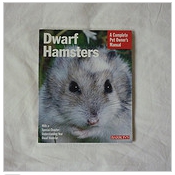
A preview of the 1999 edition of this book can be read online for free here
A preview of the 2009 edition of this book can be read online for free here
This book is also just about to be republished again in late 2012/2013.
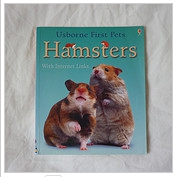
Susan Meredith, Joe Pedley, 1999, Hamsters (with Internet Links) (Usborne First Pets)
This book was republished in 2005 (2005 edition pictured). Consultants were Anne Dray and David Baglin.